OWNERS' EXPERIENCES: VENTILATION, HEATING AND COOLING IN A TALPA HOUSE
You may also be wondering whether there is enough light in an underground house, whether it is cold inside or, on the contrary, whether it overheats in summer. Are heat pumps or air conditioning necessary? As the energy-class requirements for houses tighten, people ask whether heat-recovery ventilation is really necessary. Let's take a closer look at the experiences of owners living in underground houses.
From time to time, clients have opened their homes to us, for which we are very grateful. However, we respect the owners' privacy. During visits, people often asked similar questions about heating and ventilation, which led us to collect them here. Read the answers from two clients and from the founder of our underground houses, and judge for yourself how well an underground house would suit you.
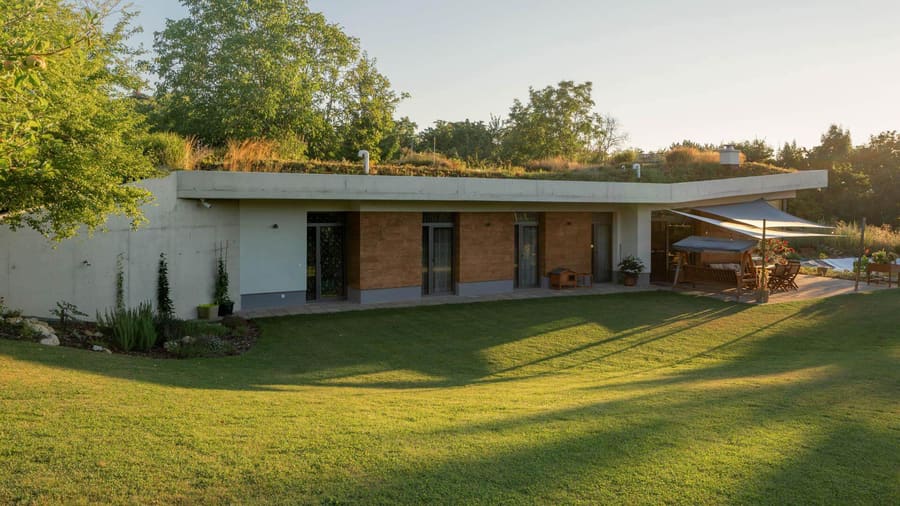
A few things our underground houses have in common: by 2020, none had air conditioning, and none had a heat pump or heat recovery in the usual sense. All of them have at least 500 mm of soil on the roof, all have large windows, and only one in ten needs a rooflight (not a light tube, but a proper rooflight you can watch the stars through). They face north, south-east or south, depending on the landscape each house is set into and, of course, on what the clients want.
Owner Juraj: Underground house on flat ground, facing south-east, passive ventilation = natural heat recovery. Shading by an awning. Materials: fired brick, timber, stone, concrete, clay plaster and a wooden floor, waterproofing against groundwater pressure.
Owner Adam: Underground house on a slope, facing north, kitchen and terrace facing west. Electric heating, passive ventilation = natural heat recovery. Materials: standard plaster, cork floor, bedrooms underground, living room and kitchen under a conventional roof. Ytong, concrete, timber, waterproofing against groundwater pressure.
Owner Martin: Founder of Talpa House. Facing south-east, no shading, no passive ventilation. Two-storey underground house. Materials: clay plaster, hemp facade, timber partitions, concrete, waterproofing against groundwater pressure.
Names have been changed; the article was approved by the clients.
VENTILATION: How do you keep the air fresh in your Talpa House?
Do you have to open windows often?
Every half hourOnce an hourOnce a dayOther…
Juraj: We air the house when cooking, as we don't have a cooker hood. The air in the house is exchanged naturally: passive heat recovery.Adam: Other.Martin: Once an hour when we have visitors. Otherwise once every 2–3 hours. In winter the air outside is often dirtier than indoors, so we don't overdo it. Not every neighbour burns dry, clean wood.
How long does it take for the air in the house to clear after COOKING, using the TOILET or having a SHOWER?5 min15 min30 minOther…
Juraj: It varies in each room.Adam: 5 min.Martin: 5 to 10 min. Sometimes we forget and only close it after an hour. That's how long it takes before we feel a change in temperature with the doors or windows open.
HUMIDITY: Ventilation is also linked to humidity. Does your nose feel dry? Do clothes dry out in the house?
How long do clothes stay fresh in the wardrobe? Don't they get damp and musty?
1 week2 weeks4 weeksOther...
Juraj: Clothes? We haven't measured that. The ideal humidity in the house is 50%.Adam: Clothes? We have a tumble dryer. Clothes stay fresh for 2 weeks.Martin: We never get a dry nose. Humidity in the house stays between 45% and 65% all year round. We don't have many clothes, so we change them often. I don't know how long they stay fresh.
COOLING: Do you have a canopy in front of the house?
Which direction is your house mainly facing?
SouthWestEastNorth
Juraj: Yes, we have a canopy. The house faces south.Adam: No, we don't have a canopy. We oriented the house to face north.Martin: We don't have a canopy yet, but we are planning one, because the windows have scorched the lawn in several places.
How do you cool your underground house?
Open the windows at nightNo needI have air conditioningOther...Can you tell us the average temperature in the house during the day, when you get home from work, or at the weekend on the terrace?
Juraj: No need for cooling. The house cools down or warms up as doors open and close when the family comes and goes.Adam: No need for cooling.Martin: We open the windows at night. It helps a little, especially when we keep them open all day so we can hear our child sleeping outside under the tree. The temperature stays at up to 25°C. In winter we reckon on burning about 1 cubic metre more wood when the window is often open.
HEATING: How long have you been living in an underground house?
Juraj: 3 years.Adam: 9 months.Martin: 2 years for us, and before that 3 years for tenants (my brother and another tenant).Which temperature do you prefer?
20–22°Caround 25°Caround 28°Cother...Juraj: 22°C is the ideal temperature for us. Up to 23; during the day we are fine below 22 too.Adam: No need for cooling. 20°CMartin: In summer, up to 25°C during the day; it can drop to 22–23°C in the morning. In winter we keep it at 21°C during the day and let it drop to 19–20°C at night.
Do you notice a difference in temperature between the bedrooms and the living room?
Up to 3°CUp to 5°CUp to 10°COther…
Juraj: Up to 3°C. For example, if the children are in their room with the door closed, it feels warmer in there.Adam: Martin: Up to 1°C. When I concentrate, I can feel the difference, but I don't usually notice it. That's why I put it at up to 1°C.
How much heating does an underground house need? Who in the family feels the cold?
Juraj: We heat very little, just enough to take the chill off.Adam: We top up the heating. My husband feels the cold.Martin: My wife feels the cold. I would prefer 19–20°C in winter; my wife is comfortable from 21°C. When it's sunny, we only heat water for washing. When it's cloudy, we have to heat the house too.
USE: What do you grow on the roof?
Once a dayOnce a weekOnce a yearNot at allOther...
Juraj: There is a lawn; nature waters it with rain.Adam: We grow things on the roof; I water it once a day.Martin: The green roof itself, with meadow grass, is watered by the rain. The part where we have a garden is watered continuously by drip irrigation with treated water from our wastewater treatment plant. As we use little water, there is also less treated water, so we plan to add a well for the garden and lawn in future.
If you could give one piece of advice to people considering an underground house, what would it be?
Juraj: If we were building again, we would build an underground house. Ours suits us; we wouldn't change anything about it.Adam: Don't hesitate. I don't regret it; I know it was the right decision.Martin: Pay attention to the quality of the details. People judge only what they can see. The quality of living is hard to recognise during a visit of 2–5 hours, but they will notice a cheap detail straight away. A cheap building looks cheap. A quality building is worth more when you come to sell. Build a pantry: it is still needed in the 21st century. It can replace a fridge, which accounts for a third of household consumption even when rated AAA.